
Decision Guide
AC Repair vs. Replacement: A Decision Framework
Every AC eventually forces the same question — fix it again, or replace it? Here's a factor-by-factor way to think it through instead of guessing.
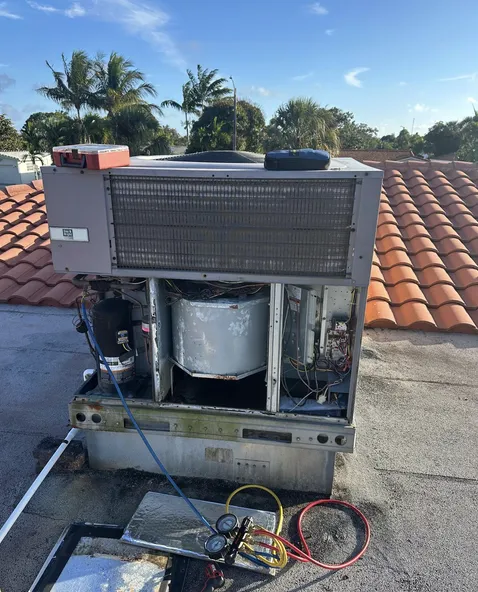
There's rarely a single obvious answer to "repair or replace." The right call depends on a combination of the system's age, its repair history, the cost of the specific failure, and how much longer you plan to own the home. Rather than a single rule, it helps to weigh each factor individually and see which way they collectively point.
Factor 1: System Age
Most central air conditioners have a realistic service life of roughly 12 to 18 years, somewhat shorter in Florida's climate due to long, humid runtimes. A system under 8 years old that needs a repair is usually worth fixing. A system past 15 years is entering the window where a major repair often isn't worth the investment. See our guide to AC lifespan in Florida for more detail on what shortens or extends that range.
Factor 2: Repair Cost Relative to Replacement Cost
Some homeowners and contractors use rules of thumb here, such as multiplying the system's age by the repair cost and comparing the result against a threshold near $5,000, or comparing a single repair against roughly a third to half the price of a new system. These are consumer planning frameworks rather than engineering standards or mandatory replacement thresholds. Actual decisions depend on system condition, repair history, refrigerant, efficiency, comfort and budget. Our AC repair cost guide outlines general ranges for common repairs to help with this comparison.
Factor 3: Repair History
One repair in five years is very different from three repairs in two years. A pattern of recurring failures, even inexpensive ones, usually signals that other components are also nearing the end of their service life and more failures are likely soon.
Factor 4: Refrigerant Type
U.S. production and import of new R-22 (HCFC-22) ended in 2020. Existing systems can still be serviced with recovered, reclaimed or previously produced R-22, although availability and cost can affect repair decisions. A refrigerant leak on an older R-22 system is one of the situations where the cost of recharging is weighed carefully against replacement. New replacement equipment increasingly uses lower-GWP refrigerants such as R-454B or other refrigerants approved for the specific equipment, while R-410A remains relevant for servicing existing systems. Refrigerants are not interchangeable and should only be handled by a qualified technician.
Factor 5: Efficiency and Comfort
Older systems lose efficiency over time even without an outright failure. If your energy bills have crept up, your home struggles with uneven temperatures between floors, or indoor humidity feels persistently high despite the AC running, a newer, correctly-sized system may solve problems that repairs alone cannot.
Side-by-Side Comparison
| Factor | Leans Toward Repair | Leans Toward Replacement |
|---|---|---|
| System age | Under 8-10 years | Past 12-15 years |
| Repair cost | Modest, isolated fix | Approaches a third+ of replacement cost |
| Repair history | First issue in years | Repeated recent failures |
| Refrigerant | System using a currently supported refrigerant | Older R-22 system |
| Comfort/efficiency | Generally comfortable, bills stable | Rising bills, humidity or uneven cooling issues |
An Honest Bottom Line
There's no shame in repairing an older system if the failure is minor and the budget favors it — plenty of 12-year-old systems run reliably for several more years after a targeted repair. Likewise, replacing a 6-year-old system over one inexpensive repair is rarely justified. The goal is matching the decision to the actual math and condition of your specific equipment, not a blanket rule. A technician who inspects the system in person, checks refrigerant type, and reviews its repair history is best positioned to help you weigh these factors for your home.
Helpful Next Steps
Frequently Asked Questions
Is there a hard rule for when to replace instead of repair?
No. Guidelines such as comparing a repair against a third to half of a new system's price, or treating 12-15 years as a decision point, are consumer rules of thumb rather than standards. They are useful for framing the conversation, but the right answer depends on the system's condition, repair history, refrigerant, efficiency and your budget.
Does one big repair mean I need a new system?
Not necessarily. A single major repair on an otherwise healthy, well-maintained system can still be the more economical choice, especially if the system is under 10 years old.
How does R-22 refrigerant affect this decision?
U.S. production and import of new R-22 ended in 2020. Existing systems can still be serviced with recovered, reclaimed or previously produced R-22, but limited availability and cost can make a large recharge expensive, which is one factor homeowners weigh against replacement.
Will a new system actually lower my energy bills?
Often yes, especially if you're replacing a system 12+ years old with a modern efficiency-rated unit, though actual savings depend on your home's insulation, ductwork, and usage patterns.
What if my system has needed multiple repairs in the past year or two?
A pattern of repeated failures, even small ones, is one of the strongest signals that a system is nearing the end of its reliable service life.
Can I keep repairing an old system indefinitely?
Sometimes, but parts availability, refrigerant cost, and declining efficiency usually make this an increasingly expensive path as a system ages.
Sources & Methodology
Repair-versus-replacement rules of thumb described here are widely used consumer planning frameworks, not engineering standards. Regulatory refrigerant statements are summarized in our own words from the sources below.
- U.S. EPA — Phaseout of Class II Ozone-Depleting Substances (HCFC-22) — Regulatory basis for the end of new U.S. R-22 production and import in 2020.
- U.S. EPA — HFC Technology Transitions — Rules moving new residential and light-commercial equipment toward lower-GWP refrigerants.
- U.S. Department of Energy — Central Air Conditioning — General guidance on system operation, efficiency and replacement considerations.
Last updated: August 30, 2026. Content is created to help Saint Johns homeowners understand common air-conditioning problems and the questions they may want to ask when requesting service. Reviewed for clarity by the Honest HVAC & AC Repair of St. Johns Editorial Team.
Not sure which side of the line you're on?
Describe your system's age and the issue it's having, and the appropriate next step can be arranged.