Skip to content
Air Conditioner Repair Saint Johns FL logoCall 904-410-4899

Air Conditioner Repair Saint Johns FL

Need help with a cooling problem in Saint Johns? Get connected for AC troubleshooting and repair assistance for systems that are not cooling, blowing warm air, leaking water, freezing up, making unusual noises or failing to start.

Serving Saint Johns, FL 32259 and nearby communities.

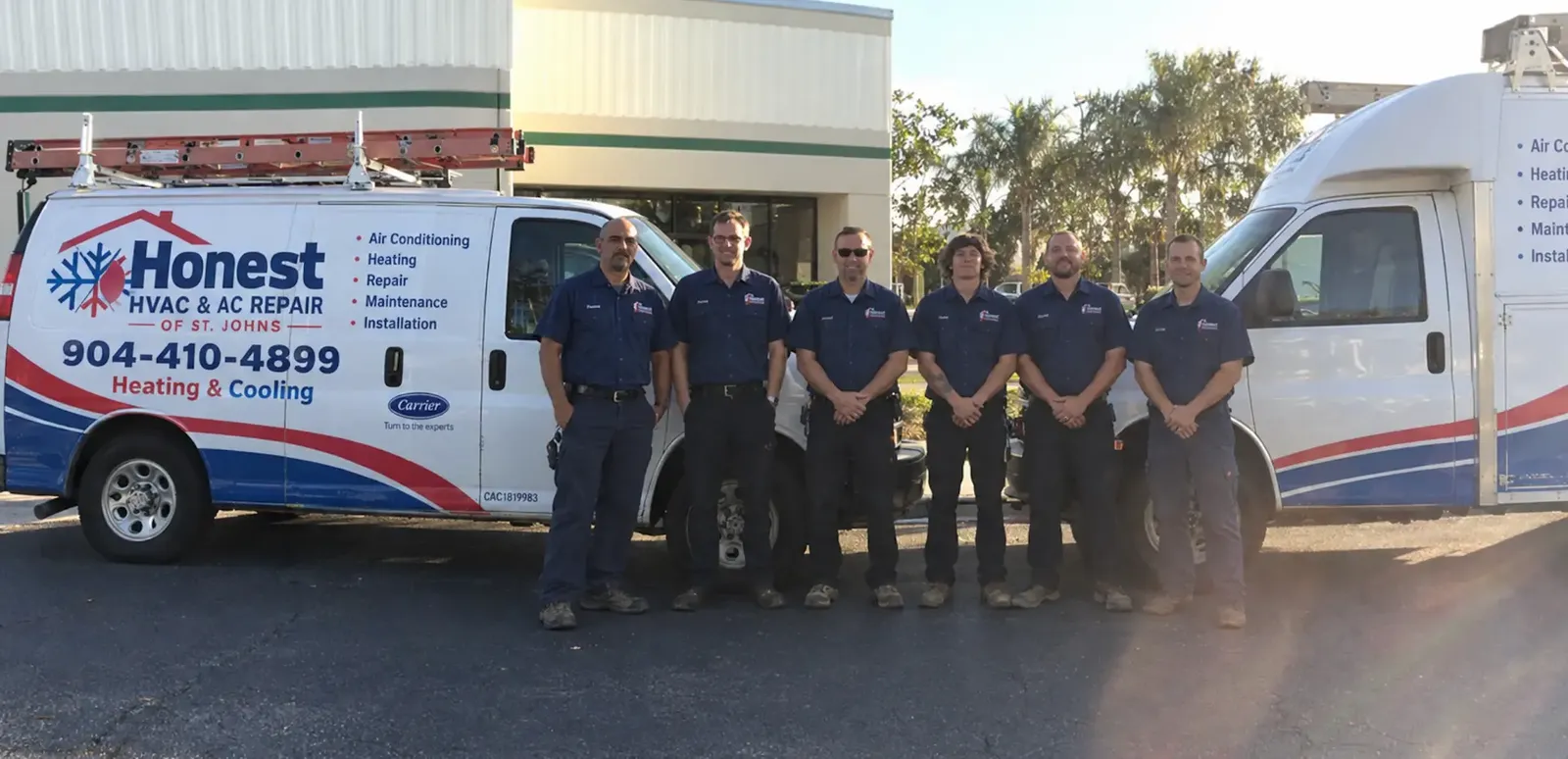
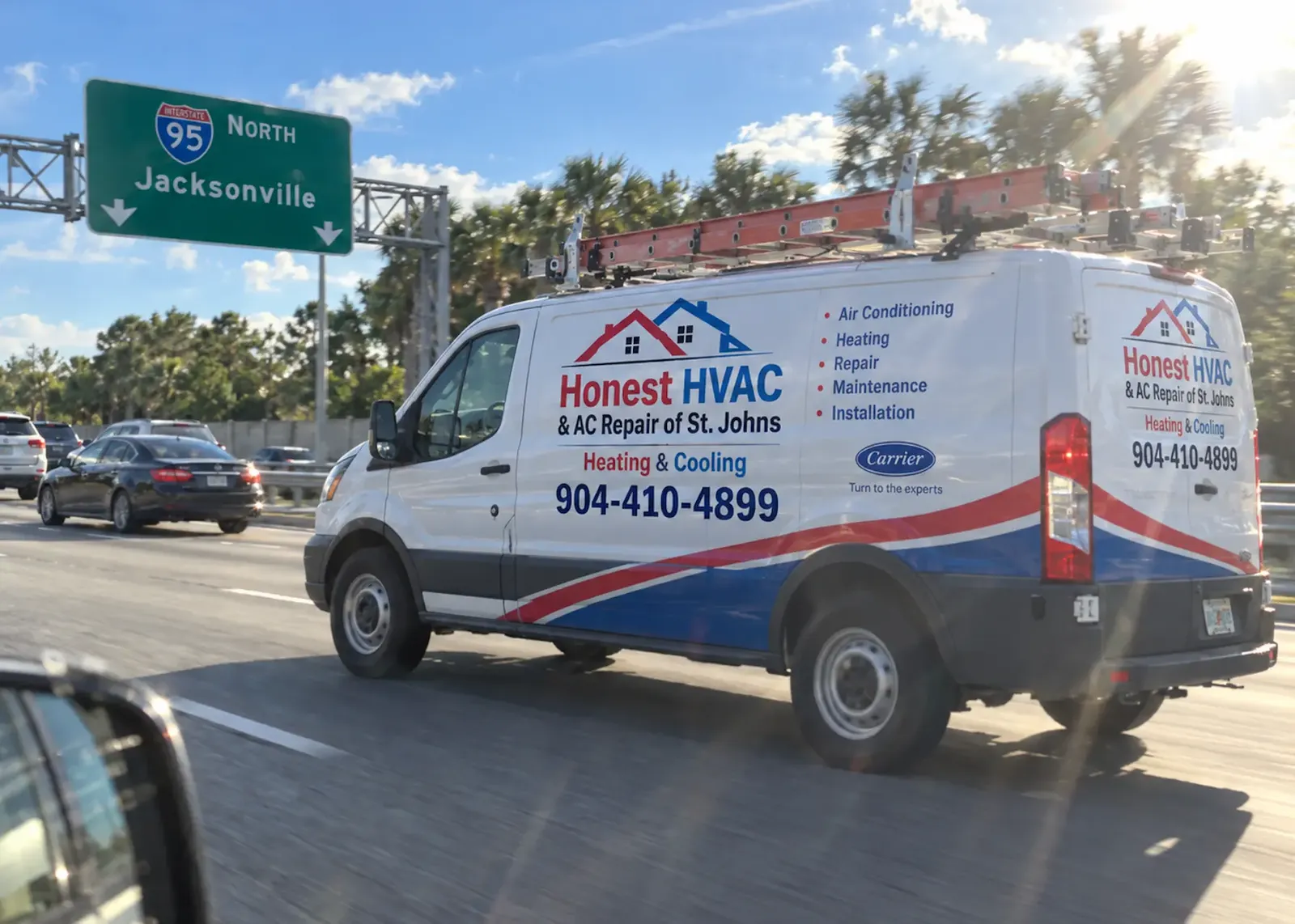
AC technician standing beside a branded service van outside a Saint Johns, Florida home

Saint Johns Focused

AC information and service coverage centered on Saint Johns and ZIP 32259.

Common AC Problems

Help for cooling failures, warm air, leaks, frozen systems, electrical issues and more.

Local Service Areas

Coverage information for Julington Creek, Durbin Crossing, Aberdeen, RiverTown and nearby communities.

Clear Next Steps

Explain your cooling problem, request service and discuss available options.

Florida Cooling Knowledge

Content designed around Northeast Florida heat, humidity and long cooling seasons.

Straightforward Information

Useful repair, troubleshooting and replacement guidance without exaggerated claims.

AC Repair in Saint Johns, Florida

Most cooling calls in Saint Johns start the same way: the thermostat is set where it always is, the system sounds like it is doing something, and the house keeps climbing anyway. Because a residential system is really two pieces of equipment working together — an outdoor condenser and an indoor air handler or furnace coil — the cause can sit on either side, and the symptom you notice inside rarely identifies which.

A system that stops cooling entirely is usually the clearest case. Sometimes the outdoor unit is silent because a breaker tripped or a contactor failed, and sometimes the indoor blower is running while the compressor is not. Reduced airflow is subtler: vents still deliver air, but not enough of it, and the home cools slowly during the hottest part of the afternoon and recovers overnight. Filters, duct restrictions, blower condition and a partially iced coil all show up this way.

Warm air at the registers points toward the refrigeration side. If the condenser fan is not turning, if the compressor is not running, or if the charge is off, the indoor coil cannot absorb heat even though the blower keeps moving air. Electrical failures behave differently again — capacitors, contactors and control boards tend to produce intermittent starts, humming, or a system that runs for a while and then quits.

Thermostat problems are worth mentioning separately because they are common and often misread as equipment failure. A control with dead batteries, a loose wire, or a programming schedule nobody remembers setting can imitate a much larger issue. So can a condensate float switch that has done exactly what it was designed to do and cut the system off before water damaged something.

On the refrigerant side, symptoms tend to arrive together: longer run times, weak cooling, ice on the suction line, and a system that struggles more as outdoor temperatures rise. Refrigerant does not get consumed, so low charge means a leak somewhere in the sealed system, and finding it takes instruments rather than guesswork. Condensate issues are the other distinctly Florida category, since a working system pulls a remarkable amount of water out of humid air every day and needs a clear path to drain it.

Outdoor condenser failures — fan motors, capacitors, contactors, coils packed with lawn debris — and indoor air handler issues such as blower motors, drain pans and coils cover most of what a Saint Johns AC service visit actually addresses. Heat pumps add reversing valves and defrost controls to that list, which matters here because so many homes in 32259 use heat pumps for both seasons. Whatever the equipment, the practical question is the same: what is failing, what does the repair involve, and does that repair make sense for the age and condition of the system.

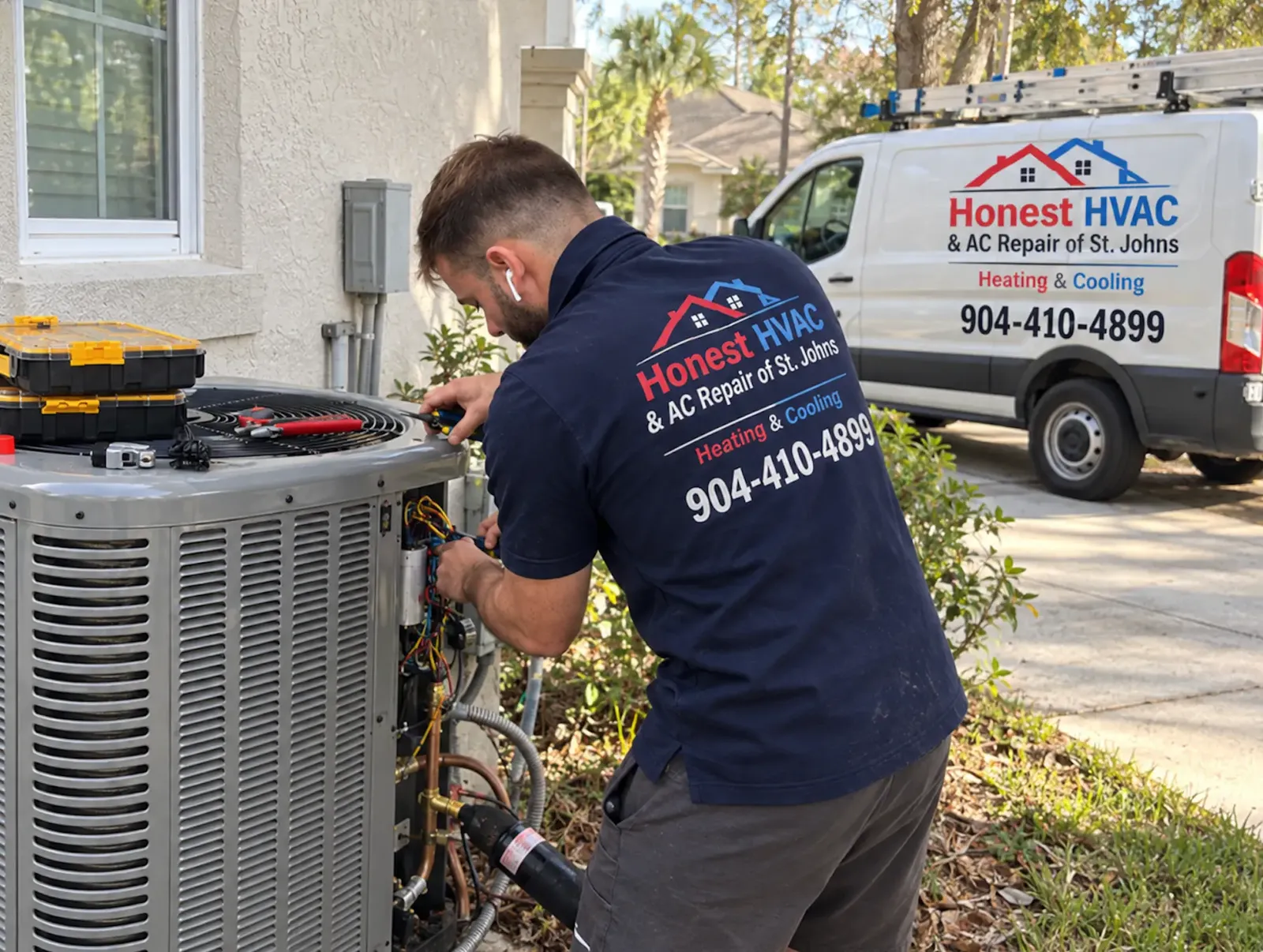
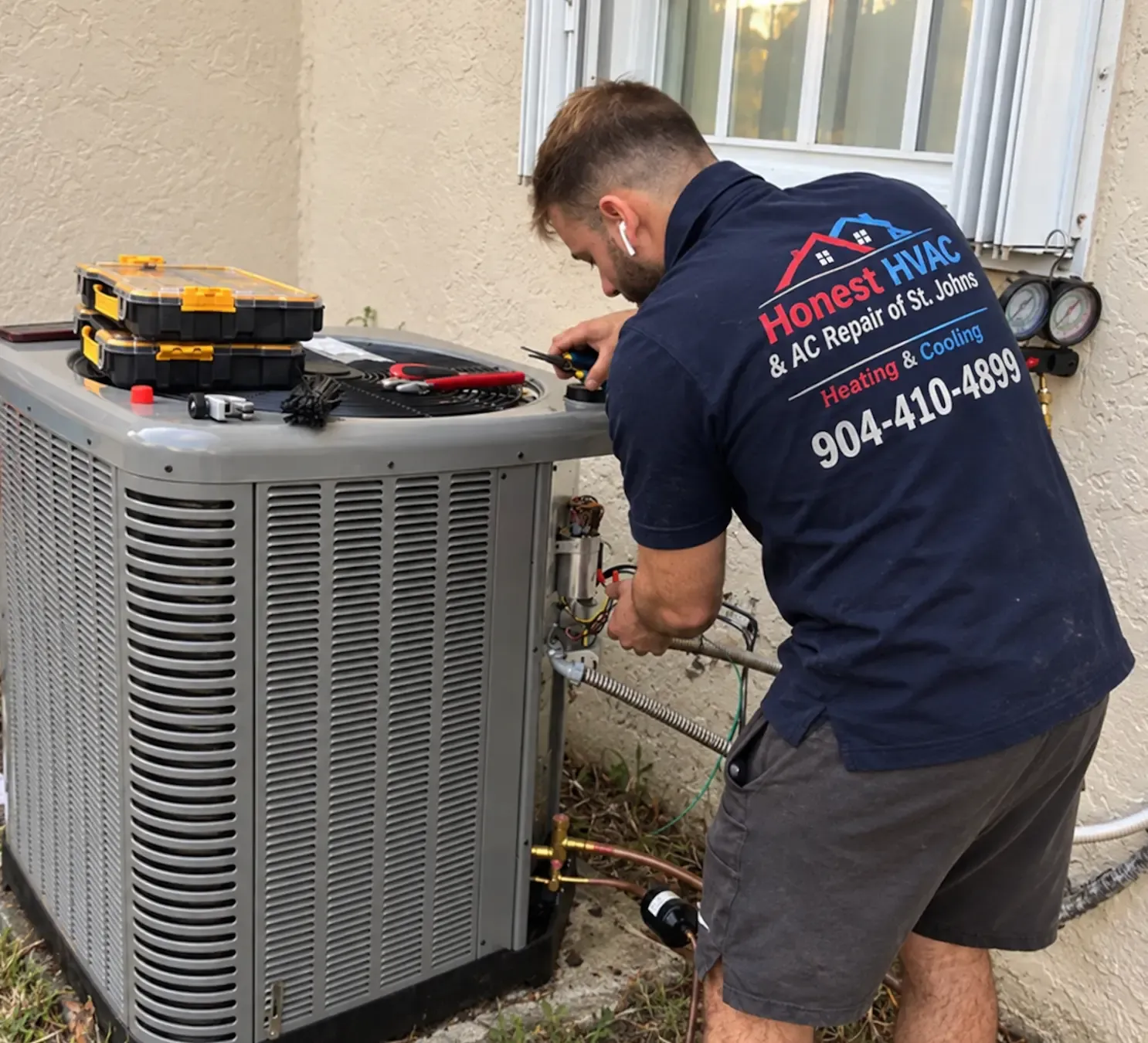
AC technician repairing an outdoor air conditioner condenser at a Saint Johns Florida homeTechnician explaining thermostat settings to a homeowner in Saint Johns, Florida

Why Isn't My AC Cooling?

Answer what you can observe safely from inside the home. The tool then lists categories a technician would typically investigate.

1. Is the HVAC system running?
2. Is air coming through the vents?
3. Does the air feel cold?
4. Do you see water near the indoor HVAC equipment?
5. Do you see ice on refrigerant lines or equipment?
6. Is the thermostat responding normally?

Answer at least three questions to see possible categories.

This tool provides general educational information and cannot diagnose an HVAC system. Multiple issues can produce similar symptoms. Proper diagnosis may require an HVAC technician.

Need help figuring it out?

Call 904-410-4899

Common AC Problems in Saint Johns, FL

High heat

Long cooling seasons can increase system runtime and component wear. Equipment here rarely gets the off-season rest that identical equipment gets further north, and motors, capacitors and contactors accumulate hours quickly.

High humidity

Indoor humidity issues may relate to system performance, airflow, maintenance, equipment sizing or other HVAC conditions. A house that feels clammy at 74 degrees is describing a moisture problem, not only a temperature one.

Condensate drain issues

Florida air conditioners can produce significant condensate, which makes drainage problems especially relevant. Clogged lines, overflowing pans and tripped float switches are a routine part of local service work.

Long system runtimes

Extended cooling cycles can increase stress on motors, capacitors, compressors and other components, and small performance losses become noticeable faster than they would in a shorter season.

Two-story comfort differences

Larger Saint Johns homes may experience upstairs and downstairs temperature differences because of duct design, sun exposure, airflow or system configuration.

Heat pumps

Heat pumps are common in Florida because mild winters suit equipment that moves heat instead of generating it. The same unit cools all summer and reverses to heat when temperatures drop, so a fault can affect both seasons.

Storms and electrical events

Electrical events during storm season may affect controls or HVAC components. If a system behaves oddly after an outage or surge, note what changed and when it started before service.

AC Repair Throughout Saint Johns, FL 32259

This site is built around one place: Saint Johns and the 32259 ZIP code that covers most of it. That corner of St. Johns County grew quickly along CR-210 and St Johns Parkway, so the housing stock skews newer, two-story floor plans are common, and a large share of homes run heat pumps installed within the past couple of decades.

Neighborhoods such as Durbin Crossing, Julington Creek, Aberdeen, RiverTown, Shearwater, Cimarrone, Twin Creeks and St. Johns Golf & Country Club each have their own mix of home ages, lot layouts and equipment vintages, which is why the service area pages discuss them separately rather than repeating one generic description.

If you are outside those communities but still inside the Saint Johns area, coverage information is on the service area page.

AC Repair Cost Estimator

Updated for 2026

Typical repair costs vary significantly depending on the exact diagnosis, system type, parts, labor, refrigerant requirements, equipment access and other conditions. Use this as planning context, not as a price.

Select an issue to see a broad market range.

Get Help With Your AC Problem

Call 904-410-4899

For a deeper breakdown by repair type, read the Saint Johns AC repair cost guide.

Family relaxing in a cool living room after air conditioning service in Saint Johns, Florida

Repair or Replace Your AC?

There is no single age at which a system should be replaced, but a few factors tend to decide it. Equipment age matters because parts availability and efficiency both fall off over time. Repair frequency matters more than any single breakdown — three service calls in two summers says something a single failure does not.

  • Severity of the current problem, especially compressor or evaporator coil failures
  • Refrigerant type and what recharging that system now involves
  • Efficiency and what runtime costs look like across a long Florida cooling season
  • Comfort issues that repairs alone will not resolve, such as humidity or room-to-room swings
  • Availability of matched parts for older or discontinued equipment
  • How long you plan to stay in the home

Read the full AC Repair vs Replacement Guide

How AC Service Requests Work

1

Tell Us What's Happening

Describe the symptom, when it started and what the system is doing now.

2

Discuss the Cooling Problem

Talk through the details so the situation is understood before anything is scheduled.

3

Arrange the Appropriate Next Step

Your service request can be reviewed so the appropriate next step can be arranged.

4

Review Findings and Available Options

After an on-site evaluation, findings and available options can be discussed.

Depending on availability and the nature of the request, service may be provided or coordinated through an appropriate local service provider. More detail is on the how it works page.

Saint Johns AC Repair FAQs

Why is my AC running but not cooling?

A system can run while producing little cooling when airflow is restricted, when the outdoor unit is not operating correctly, when refrigerant charge is not where it should be, or when a control problem keeps part of the system from starting. Because several causes look alike from inside the home, the outdoor unit and indoor equipment usually both need to be checked.

Why is my AC blowing warm air?

Warm air at the vents often points to the outdoor side of the system: a condenser fan that is not turning, a contactor or capacitor failure, or a compressor that is not running. It can also happen if the thermostat is set to fan-on rather than cool, or if the system has iced over and airflow is passing across a blocked coil.

Why is water leaking around my indoor AC unit?

In Florida the most common reason is a condensate drain that has partially or fully clogged, which causes the drain pan to overflow. A cracked pan, a disconnected drain, a failed float switch, or a coil that has frozen and then thawed can produce the same puddle.

Why does my AC keep freezing?

Ice forms when the evaporator coil gets too cold, which usually traces back to restricted airflow or a refrigerant charge problem. Loaded filters, closed or blocked vents, duct restrictions, a weak blower, and leaks in the sealed system are all part of that picture.

Should I turn my AC off if it is frozen?

Switching the system from cool to off, and setting the fan to on if your thermostat allows it, is the common way to let ice melt without running the compressor against a blocked coil. Plan for water as the ice melts, and have the underlying cause checked before running in cooling again.

What can cause an air conditioner not to turn on?

No-start conditions are frequently electrical: a tripped breaker, a condensate float switch that has opened, a failed capacitor or contactor, a control board fault, or a thermostat that has lost power. These involve high voltage and internal components, so they should be evaluated by a technician rather than opened up at home.

Why is my upstairs warmer than downstairs?

Heat rises, upper floors take more roof and window load, and duct runs to second-floor rooms are often longer. Duct design, register balancing, insulation, sun exposure and equipment configuration all influence the difference, so the fix depends on which of those is dominant in your home.

How long do AC systems typically last in Florida?

Northeast Florida systems run many more hours per year than systems in cooler climates, so useful life is often discussed in the range of roughly ten to fifteen years, with maintenance, installation quality, coastal exposure and usage all affecting the outcome. Some systems last longer, and some fail earlier.

Should I repair or replace an older AC system?

The usual factors are equipment age, how often it has needed repairs, the cost and severity of the current problem, refrigerant type and availability, efficiency, and how long you plan to stay in the home. A large sealed-system repair on an older unit is the point where most homeowners price both options.

Do heat pumps provide both heating and cooling?

Yes. A heat pump moves heat rather than generating it, so the same equipment cools in summer and heats in cooler months by reversing that flow. Heat pumps are common in Saint Johns because winters are mild and the cooling season is long.

Last updated: August 30, 2026. Content is created to help Saint Johns homeowners understand common air-conditioning problems and the questions they may want to ask when requesting service. Reviewed for clarity by the Air Conditioner Repair Saint Johns FL Editorial Team.

Talk through your AC problem: 904-410-4899

Describe the symptom and the appropriate next step for your Saint Johns home can be arranged.

Call NowRequest Service